 BXL
Early Bovine Pregnancy Detection: Improving Cattle Reproductive Efficiency with Advanced Veterinary Ultrasound Technology
Early Bovine Pregnancy Detection: Improving Cattle Reproductive Efficiency with Advanced Veterinary Ultrasound Technology
Introduction: Why Early Bovine Pregnancy Detection Matters
Early bovine pregnancy detection is an essential part of modern cattle reproductive management. For dairy farms, beef cattle operations, veterinary clinics, and artificial insemination (Искусственный интеллект) centers, identifying pregnant and non-pregnant cows as early as possible helps improve breeding efficiency, reduce reproductive losses, and optimize herd productivity.
Traditional pregnancy diagnosis methods, such as rectal palpation, are widely used in cattle reproduction. Однако, veterinary ultrasound technology provides additional advantages by allowing veterinarians to examine the uterus, identify early pregnancy structures, evaluate ovarian conditions, and monitor reproductive development.
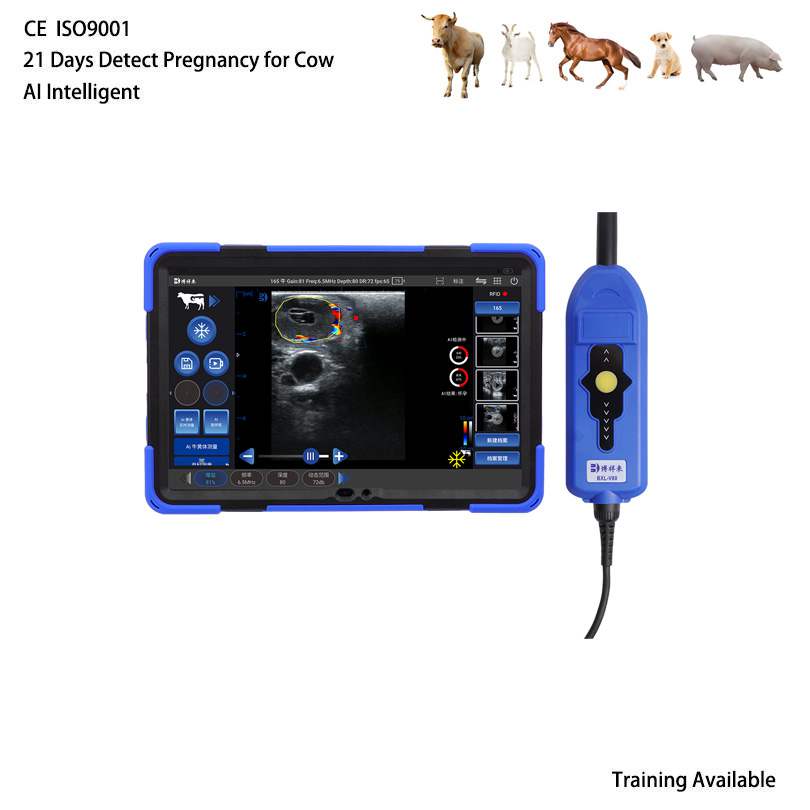
With the development of advanced veterinary imaging equipment, bovine pregnancy ultrasound has become an increasingly valuable tool for early pregnancy diagnosis and herd reproductive management.
Zhengzhou Boxianglai Electronic Sci-Tech Co., ООО. (BOXERLY) specializes in the research, development, and manufacturing of veterinary ultrasound scanners. Our large-animal ultrasound solutions are designed to support veterinarians, cattle breeders, distributors, and livestock production companies worldwide.
1. When Can Early Bovine Pregnancy Be Detected?
One of the most common questions among cattle farmers and veterinarians is: How early can you detect pregnancy in a cow after artificial insemination?
The answer depends on the ultrasound equipment, probe frequency, examination technique, operator experience, and individual reproductive conditions.
Transrectal B-mode ultrasound is commonly used for early pregnancy diagnosis in cattle.
The following timeline provides a general reference:
Days after AI Ultrasound examination
18–21 days Early reproductive examination; pregnancy confirmation may be challenging
21–25 days Early pregnancy structures may become detectable under suitable conditions
25–30 days More reliable identification of the gestational sac and embryo
30–35 days Embryo visualization and assessment of embryonic development
35–45 days Clearer fetal structures and heartbeat examination
Important: Pregnancy diagnosis before 30 days requires appropriate equipment and experienced operators. A negative or uncertain early scan should be followed by a repeat examination.
For commercial cattle farms, ultrasound pregnancy diagnosis around 28–30 days after AI is a practical approach, while earlier examinations can be used by experienced veterinarians with suitable equipment.
2. How Does Veterinary Ultrasound Detect Early Pregnancy in Cows?
Veterinary ultrasound scanners use high-frequency sound waves to produce real-time images of internal reproductive structures.
During a transrectal examination, a veterinarian inserts a suitable rectal ultrasound probe into the rectum to examine the uterus and ovaries.
Several important structures can be evaluated.
2.1 Identification of the Gestational Sac
One of the early ultrasound findings is the appearance of a fluid-filled gestational sac within the uterine horn.
It appears as an anechoic or dark area on the ultrasound screen.
Identifying this structure is an important step in early bovine pregnancy diagnosis. Однако, the operator must distinguish it from other uterine fluid accumulations.
2.2 Embryo Visualization
As pregnancy progresses, the embryo becomes increasingly visible inside the gestational sac.
A high-resolution veterinary ultrasound machine helps veterinarians identify embryonic structures and evaluate early development.
2.3 Fetal Heartbeat Detection
One of the most important indicators of embryonic viability is the presence of a heartbeat.
Real-time ultrasound imaging allows veterinarians to observe cardiac activity when the embryo has developed sufficiently for reliable visualization.
This provides valuable information beyond simply determining whether a cow is pregnant.
2.4 Corpus Luteum Examination
The corpus luteum (CL) plays an essential role in maintaining pregnancy through progesterone production.
Veterinary ultrasound can help examine ovarian structures and identify the corpus luteum.
With advanced Color Doppler and Power Doppler technology, veterinarians can also evaluate blood flow within ovarian structures, providing additional information for reproductive monitoring.