 BXL(ビーエル)
Cattle Pregnancy Diagnosis at 21 Days: How Color Doppler Ultrasound Helps Detect Early Pregnancy
Early pregnancy detection is one of the most important aspects of modern cattle reproduction management. For dairy farms, beef cattle operations, 動物病院, and artificial insemination professionals, identifying pregnancy status as early as possible can help improve reproductive efficiency, reduce unnecessary waiting periods, and optimize herd management.
Traditionally, cattle pregnancy diagnosis has relied on rectal palpation, conventional B-mode ultrasound, and pregnancy-associated hormone testing. しかし, advances in veterinary ultrasound technology have introduced new possibilities for early pregnancy detection in cattle, particularly around 20–21 days after artificial insemination (AI).
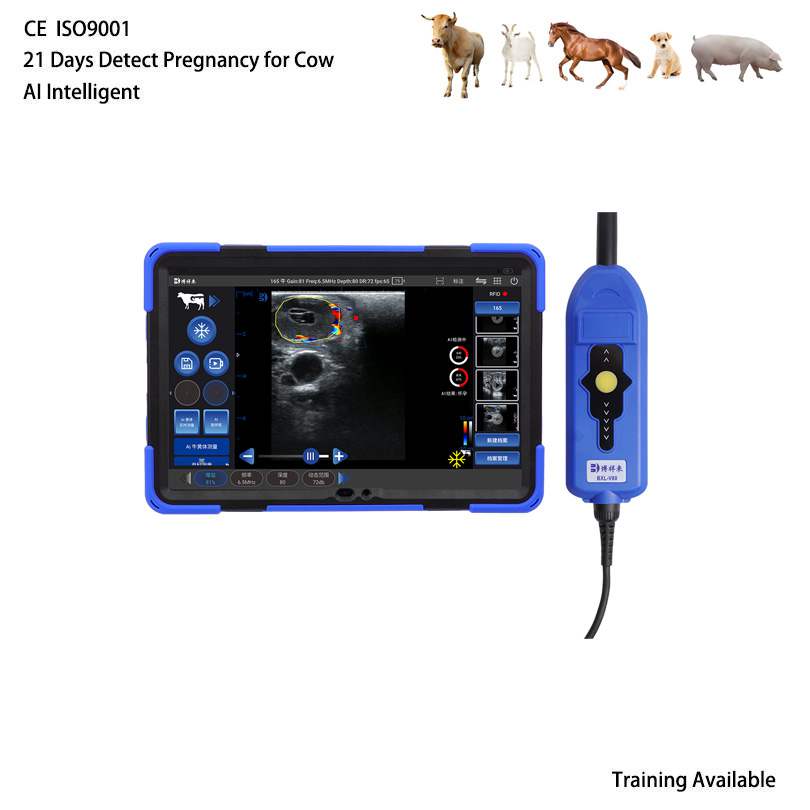
So, can you perform cattle pregnancy diagnosis at 21 日?
The answer is that color Doppler ultrasound can provide valuable information about early pregnancy status by evaluating blood circulation in the corpus luteum (CL). This technique offers an additional approach to early reproductive assessment before the embryo can be reliably visualized using conventional ultrasound.
この記事の内容, BOXERLY explores the principles of 21-day cattle pregnancy screening, the role of Doppler technology, and how advanced veterinary ultrasound equipment supports more efficient cattle reproduction management.
1. Can You Detect Pregnancy in Cows at 21 Days?
はい, early pregnancy assessment around 21 days after insemination is possible using specific reproductive ultrasound techniques.
しかし, it is important to understand the difference between early pregnancy screening and definitive pregnancy confirmation.
At approximately 21 days after artificial insemination, the embryo may still be too small to identify reliably through conventional B-mode ultrasound. Therefore, simply looking for an embryo or gestational sac is not always sufficient at this stage.
Instead, veterinarians can evaluate several reproductive indicators, 含む:
Corpus luteum (CL) development and morphology.
Corpus luteum blood flow and vascularization.
Changes in uterine appearance.
The presence of uterine fluid.
Reproductive history and insemination records.
Color Doppler ultrasound makes it possible to visualize blood circulation within and around the corpus luteum, providing additional information for early pregnancy assessment.
Research published in the Journal of Dairy Science has demonstrated that combining corpus luteum blood flow, CL size, and uterine characteristics can help predict pregnancy status on Day 21 after artificial insemination.
This makes Doppler technology a valuable tool for veterinarians interested in early cattle pregnancy diagnosis.
2. How Does Color Doppler Ultrasound Detect Early Pregnancy in Cattle?
To understand how a 21-day pregnancy assessment works, it is necessary to understand the role of the corpus luteum.
What Is the Corpus Luteum (CL)?
The corpus luteum is a temporary endocrine structure that develops in the ovary after ovulation.
Its primary function is to produce progesterone, a hormone essential for maintaining pregnancy.
After successful fertilization and embryo development, the embryo produces signals that help maintain the corpus luteum and prevent its regression.
In a non-pregnant cow, the corpus luteum normally undergoes regression as part of the reproductive cycle.
These physiological differences can influence the blood supply and structure of the corpus luteum.
Why Is Corpus Luteum Blood Flow Important?
Color Doppler ultrasound allows veterinarians to observe blood circulation within the corpus luteum.
By evaluating its vascularization, veterinarians can identify differences in luteal blood flow between pregnant and non-pregnant cows.