 BXL
21 Day Pregnancy Test for Cows: How Ultrasound Technology Helps Detect Early Pregnancy
For modern cattle farms, identifying pregnant cows as early as possible is an important step toward improving reproductive efficiency and managing breeding costs. The earlier a veterinarian can identify cows that are likely to be pregnant or non-pregnant, the sooner the farm can make informed decisions about insemination, herd management, and reproductive planning.
A common question among dairy farmers, cattle breeders, and veterinary professionals is: Can you perform a 21 day pregnancy test for cows?
With advanced veterinary ultrasound technology and appropriate examination techniques, early pregnancy assessment around 21 days after insemination may be possible in selected cases. Toutefois, this is an advanced diagnostic task. Results depend on the cow’s reproductive status, the equipment and examination method used, and the experience of the veterinary professional.
Zhengzhou Boxianglai Electronic Sci-Tech Co., Ltd., the manufacturer behind the BOXERLY brand, develops veterinary ultrasound imaging equipment designed to support cattle pregnancy diagnosis, reproductive monitoring, and livestock breeding management.
1. Can You Test a Cow for Pregnancy at 21 Days?
The answer depends on the diagnostic method.
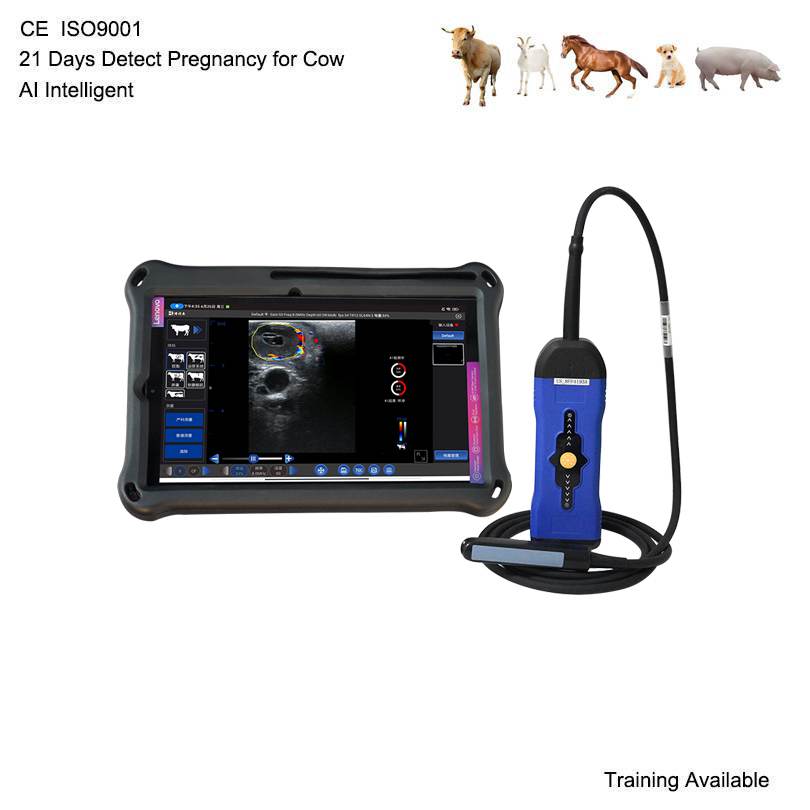
Many cattle reproductive management programs use ultrasound examinations at approximately 28–35 days after insemination. Earlier examinations may be possible with suitable equipment and experienced operators, but detecting pregnancy at around 21 days requires particular care.
At this early stage, the embryo and associated reproductive structures are small. A routine ultrasound examination may not provide sufficient evidence to confirm pregnancy in every cow.
Veterinarians should distinguish between three important situations:
– Early pregnancy assessment: Looking for findings that may indicate an established pregnancy.
– Ovarian and corpus luteum assessment: Examining ovarian structures and, when suitable equipment and Doppler techniques are available, their blood-flow characteristics.
– Confirmation de grossesse: Identifying reliable diagnostic evidence and deciding whether a follow-up examination is needed.
A cow should not automatically be classified as pregnant simply because a corpus luteum is present. Corpus luteum structures can also be found in non-pregnant cows.
For this reason, un 21 day pregnancy test for cows should be understood as an early diagnostic assessment that requires appropriate interpretation, rather than a guaranteed pregnancy confirmation for every animal.
2. Why Is Early Pregnancy Detection Important for Cattle Farms?
Every missed breeding opportunity can affect herd productivity. When pregnancy status remains uncertain for too long, farmers may lose valuable time before making the next breeding decision.
An effective early pregnancy detection program can help farms:
Reduce unnecessary waiting time
Earlier identification of cows that are likely to be non-pregnant can help veterinarians plan follow-up examinations and subsequent breeding at the appropriate time.
Improve reproductive management
Pregnancy records, insemination dates, ovarian findings, and follow-up results can be combined to support more organized herd management.
Support dairy farm productivity
For dairy operations, reproductive performance influences calving intervals, milk production planning, replacement strategies, and overall herd efficiency.
Make better use of veterinary resources
Portable cattle ultrasound equipment allows trained professionals to conduct examinations at the farm instead of relying exclusively on off-site diagnostic services.
The goal is not simply to detect pregnancy earlier. It is to obtain useful diagnostic information that supports sound breeding decisions.
3. How Does Ultrasound Help With a 21 Day Pregnancy Test for Cows?
Veterinary ultrasound imaging allows trained operators to examine reproductive structures in real time.
For early cattle pregnancy assessment, the examination method must match the stage of gestation and the diagnostic question.
Conventional B-Mode Ultrasound
B-mode ultrasound produces two-dimensional grayscale images of internal structures. With a suitable rectal probe, an experienced veterinarian can examine the uterus and ovaries and evaluate visible reproductive findings.
Conventional ultrasound is widely used for cattle pregnancy diagnosis at appropriate gestational stages. Its performance depends on image quality, probe selection, examination technique, and operator experience.
For examinations around day 21, a negative or inconclusive finding should not automatically be interpreted as proof that the cow is not pregnant.
Color Doppler and Power Doppler Ultrasound
Doppler ultrasound adds blood-flow information to conventional anatomical imaging.