 BXL
21 Days Post Insemination Cow Ultrasound: Can You Detect Pregnancy So Early?
Why Is Day 21 Important for Cow Pregnancy Detection?
For dairy farmers, cattle breeders, and veterinary professionals, identifying pregnant and non-pregnant cows as early as possible is essential for improving reproductive efficiency and herd profitability.
After artificial insemination (AI), farmers naturally want to know whether a cow has conceived. Traditionally, pregnancy diagnosis requires waiting several weeks before reliable confirmation. Sin embargo, advances in veterinary ultrasound technology have made earlier reproductive assessment increasingly practical.
Un 21 days post insemination cow ultrasound examination provides valuable information about reproductive changes, particularly the corpus luteum (CL), its blood supply, and the condition of the uterus.
With modern Color Doppler ultrasound technology, veterinarians can evaluate luteal blood flow and identify differences associated with pregnancy status. This creates an opportunity for earlier reproductive management and more efficient breeding programs.
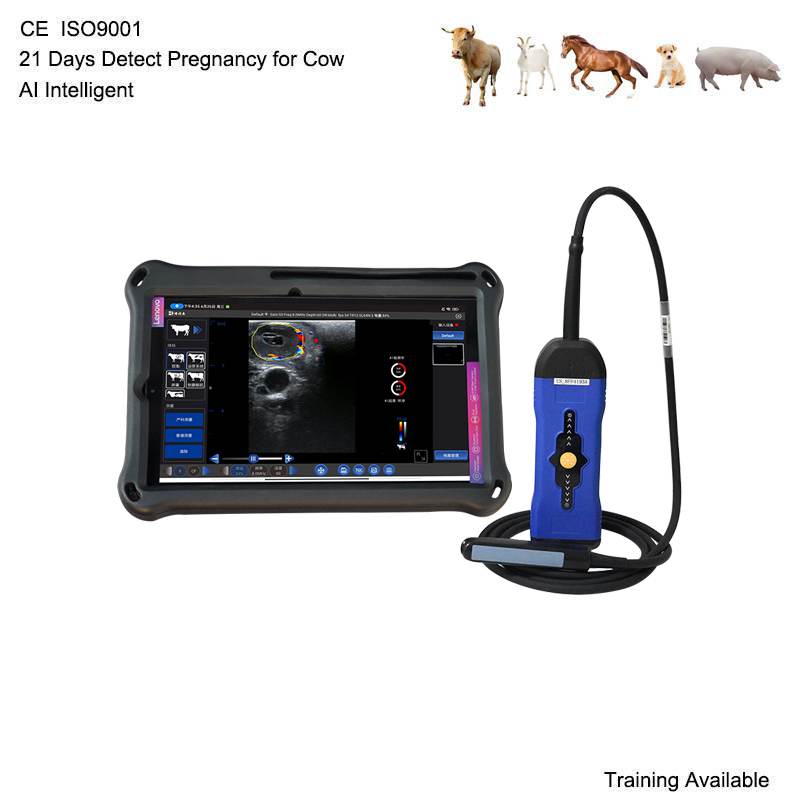
But can you really detect cow pregnancy 21 days after AI?
Let’s explore the science, ultrasound examination methods, and equipment that make early pregnancy assessment possible.
1. What Happens in a Cow 21 Days After Insemination?
Understanding the reproductive cycle is important before performing an early pregnancy ultrasound.
Following successful artificial insemination, the fertilized embryo develops inside the reproductive tract. During early pregnancy, the embryo produces signals that help maintain the corpus luteum.
The corpus luteum is a temporary ovarian structure responsible for producing progesterone, a hormone essential for maintaining pregnancy.
In a non-pregnant cow, the corpus luteum normally undergoes regression around the end of the estrous cycle. Progesterone levels decrease, allowing the cow to return to estrus.
In a pregnant cow, the corpus luteum is maintained, supporting continued progesterone production.
At approximately 21 days after insemination, several reproductive indicators can be evaluated:
Corpus luteum size and morphology.
Corpus luteum blood perfusion.
Changes in ovarian structures.
Uterine characteristics.
Differences between pregnant and non-pregnant reproductive patterns.
These physiological changes provide important information for early bovine pregnancy diagnosis.
2. How Does Ultrasound Detect Pregnancy 21 Days After AI?
A veterinary ultrasound scanner allows veterinarians to examine the reproductive organs of cattle without invasive surgery.
For early pregnancy assessment, transrectal ultrasonography is commonly used. A suitable rectal linear probe provides detailed images of the ovaries and uterus.
There are two important ultrasound approaches.
Un. B-Mode Ultrasound Examination
B-Mode ultrasound produces grayscale images of reproductive structures.
Veterinarians can use it to evaluate:
Corpus luteum size and appearance.
Ovarian structures.
Uterine wall characteristics.
Uterine fluid and other reproductive changes.
Sin embargo, en 21 days after artificial insemination, a visible embryo may not always be identifiable. Por lo tanto, B-Mode findings alone should not automatically be considered definitive evidence of pregnancy.
B. Color Doppler Ultrasound: Evaluating Corpus Luteum Blood Flow
Color Doppler technology provides additional information by displaying blood circulation within reproductive tissues.
One of the most interesting applications is evaluating corpus luteum blood flow (CLBF).
In many pregnant cows, the corpus luteum remains functional and maintains substantial vascular activity. In non-pregnant cows, luteal blood flow may decrease as luteal regression begins.
By examining the blood perfusion pattern of the corpus luteum, experienced veterinarians can identify differences associated with pregnancy status.
Important examination parameters include:
Blood flow distribution within the corpus luteum.
Relative vascular perfusion area.
Corpus luteum size.
Combined ovarian and uterine ultrasound findings.
Research published in the Journal of Dairy Science demonstrated that combining corpus luteum blood flow, corpus luteum size, and uterine characteristics on Day 21 could provide highly accurate pregnancy predictions in the studied dairy cows.
This demonstrates the potential of Color Doppler ultrasound for early pregnancy assessment.
3. Why Is Corpus Luteum Blood Flow Important for Early Pregnancy Diagnosis?
The corpus luteum plays a critical role in maintaining bovine pregnancy.
Its primary function is progesterone production, which supports the uterine environment required for embryo development.
The relationship between luteal blood circulation and pregnancy status makes Color Doppler technology particularly useful.